Why a Path Bends: Reading the Shape of a Walking Route
Choose a walking route shape that fits your day: compare loops, out-and-back walks, and linked paths by how each changes your choices on the trail.
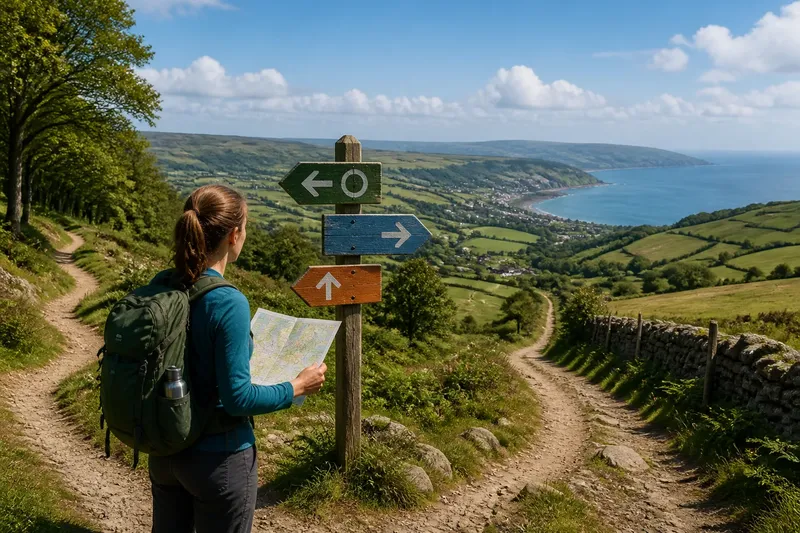
A walking route shape can decide whether your day feels like a steady return, a small circuit, or a journey through changing places. Look at a route on a map and ask one useful question: do you want to finish where you started, revisit the same ground, or keep moving toward somewhere new? The answer narrows the choice before you get distracted by every bend in the line.
What does each route shape ask of you?
An out-and-back route follows one path to a chosen point, then returns along it. A loop circles back to its starting area by a different stretch of trail. A linked route joins paths to travel between distinct places, often with an endpoint away from the start. Some routes combine these forms, but it helps to identify the main shape first.
These are not rankings. A loop is not automatically more interesting, and an out-and-back is not a lesser version of a journey. Each shape arranges the walk differently: what you see again, where you can turn around, and how much the finish depends on a separate ride or pickup.
When does an out-and-back fit best?
Choose an out-and-back when you want a simple structure and the freedom to set the turnaround point as you go. It suits a short day with a clear destination, such as a riverside viewpoint, a sheltered picnic spot, or the end of a wooded lane. If the weather or your energy changes, you can turn back without needing to complete a circuit.
The return has its own character. A familiar ridge or stream appears from the opposite direction, and details that were behind you on the way out come into view. That can feel reassuring, though a long stretch of repeated scenery may become less engaging if you prefer constant change.
This shape also works when the start and finish need to be the same place. You can leave a car at a trailhead or begin and end near a bus stop without arranging a second pickup. The path itself makes the return possible; there is no separate endpoint to reach.
One limitation is that the distance to your destination is only half the outing. A landmark that looks close on a map still requires a return along the same route. If you are unsure how far you want to walk, choose a natural turnaround point rather than treating the farthest visible feature as an obligation.
When does a loop make the day feel fuller?
A loop fits when you want to return to the same general starting place but see different ground along the way. It can connect a wooded track with a field edge, or circle a hill through a sheltered valley on one side and open slopes on the other. The change in surroundings is part of the appeal, not just a way to avoid retracing your steps.
Loops are especially convenient when your transport is fixed. You can leave from a village car park, a trailhead, or a stop near a café and return to that same area. The ending is easy to picture, which can make the day simpler to arrange.
But a loop gives you less freedom to shorten the walk if the route has no useful cross-paths. A turn on an out-and-back naturally sends you home; leaving a loop midway may mean a longer detour or an uncertain way back. Look for where paths join, and notice whether those connections make a genuine shorter return rather than an awkward cut across the map.
Loops can also disguise the character of the return. A line may appear pleasantly circular but spend much of its distance on quiet access tracks or a road. That is not necessarily a reason to reject it. It is a reason to decide whether those sections suit the kind of walk you want.
When should you link paths between two places?
Choose a linked route when the destination matters as much as the walking: perhaps you want to travel from one village to another, follow a valley through, or end near a different transit stop. The route becomes a small journey rather than a circuit. The changing start and finish can give the day a satisfying sense of arrival.
This shape asks for more coordination. You may need a bus, a train, a lift, or a companion willing to move a vehicle. If the transport is infrequent or the endpoint is remote, the walk can become dependent on arrangements that are less flexible than the path itself.
Linked paths can also be useful when the landscape naturally points in one direction. A river corridor, a long ridge, or a route between settlements may make a through-walk feel more coherent than forcing a loop. The trade-off is that you cannot simply follow the path back to the start without adding substantial distance.
Say you want a relaxed walk between two neighboring villages and can arrange a ride at the far end. A linked path may fit because it lets you finish where the landscape leads, while a loop would send you back toward the first village. If the pickup becomes uncertain, the same route may no longer be the comfortable choice; the transport plan is part of its shape.
Which route shape fits your situation?
- You want an easy turnaround: Pick an out-and-back with a clear point where you can pause and head home. It keeps the return straightforward and lets you adapt the distance.
- You want changing scenery without moving your car: Look for a loop that returns to the same starting area by a genuinely different path. Check that the closing section is one you are happy to walk.
- You have a destination and a ride at the far end: Consider linked paths. They suit a point-to-point day when the endpoint is part of the plan, not an afterthought.
- You are walking with someone who may want to stop early: Favor an out-and-back or a loop with a clear, usable shortcut. A long linked route can be harder to shorten without changing the pickup plan.
- You want the path itself to feel like a journey: A linked route often gives the strongest sense of moving through a landscape. Choose it only if the finish is practical for everyone in the group.
- You are unsure which way you will feel on the day: An out-and-back usually leaves the most obvious choice to turn around. A loop can still work, but its options depend on the paths that connect its sections.
What is not worth the effort is trying to make every route shape sound better than the others. A loop is not automatically more adventurous, and a line that ends elsewhere is not automatically more meaningful. Match the shape to the day you actually want.
What should you check before choosing a shape?
Look at the route as a sequence of decisions, not only as a drawing. For a loop, identify where the return begins and whether the two halves offer the contrast you want. For an out-and-back, choose a plausible turning point. For a linked route, settle the endpoint and its transport before you set out.
Then consider how much flexibility each option leaves you. A path with several connecting trails may let you shorten a loop, while a single corridor may make an out-and-back easier to adjust. A linked route can feel straightforward if the pickup is settled, but frustrating if it depends on an uncertain connection.
Route shape also changes how you experience familiar ground. On an out-and-back, the same path can reveal a different view on the return. On a loop, the landscape changes while the start stays fixed. On a linked walk, the setting and endpoint move together. Think about which kind of change sounds appealing, rather than assuming new ground is always better.
How do route shapes affect common choices?
Is a loop better than an out-and-back?
Neither is better by default. A loop offers different scenery while returning you to the same area, while an out-and-back makes it easier to choose a turnaround point and revisit a familiar path.
Can you shorten a loop?
Only if the paths provide a sensible connection back toward the start. Check for a usable cross-path before choosing the loop; otherwise, leaving midway may not save much walking.
What is a point-to-point walking route?
It is a route that starts and finishes in different places, often by linking existing paths. It suits a destination-led walk when you have a practical way to leave the endpoint.
Which route shape is easiest to plan with a fixed start?
An out-and-back is often the simplest because its finish is the same as its start and its turnaround can remain flexible. A loop also returns to the start, but its full circuit may offer fewer easy ways to shorten the outing.
How can you make the route shape work for your day?
Start with the ending you want. If you want to finish at the same place without retracing the path, look for a loop. If you want the option to turn around whenever the day calls for it, choose an out-and-back. If a particular village, viewpoint, or transit stop should be your destination, consider linking paths between two places.
Then check whether the route’s structure supports that choice. A loop needs a comfortable way back; an out-and-back needs a reasonable turnaround; a linked walk needs a dependable plan for the endpoint. Local access, path conditions, and transport can change what is practical, so check current information and follow the relevant route and access guidance.
For a walking route, shape is a quiet kind of planning. It influences whether the familiar becomes a pleasure, whether a new view arrives around the next bend, and whether the finish feels settled or requires another arrangement. Choose the form that gives your day the ending you want, and let the path’s turns take care of the rest.