A Short Winter Day Out, Built Around the Light
Plan a short winter day out around daylight, warm pauses and an unhurried return, so the route feels complete without stretching the afternoon.
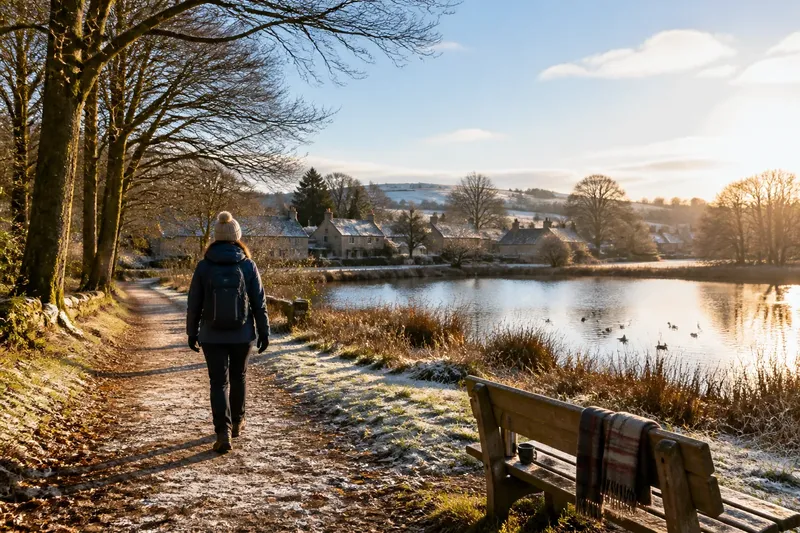
For a short winter day out, the useful question is not how far you can walk before dusk, but what you want the afternoon to feel like on the way back. Imagine a hypothetical Saturday with a clear morning, a late-rising sun and a small nature reserve near a village. You want time outdoors, a warm pause and a settled return—not a race against fading light. Build the day around those three parts, and the route can be modest without feeling like a compromise.
What should the daylight make possible?
Start with the shape of the light rather than a distance target. Check the local sunrise and sunset, then consider when the ground and scenery will be easiest to enjoy. A wooded path may stay dim even after sunrise; an open ridge can feel exposed in wind. In winter, low sun also changes what you can see: frost catches the light, while a shaded path may remain slippery after brighter fields have thawed.
For the imagined Saturday, the walker chooses a late-morning start. That leaves the brightest part of the day for the open section and keeps the shaded woodland for earlier, when the route is still near the village. The plan does not treat sunset as a finish-line target. It allows the walk to end while there is still enough light for an unhurried last stretch and a look back at the view.
Check the forecast as well as the daylight. Cloud, rain, wind and ground conditions can alter the feel of a route, even when the sunset time stays the same. A familiar path with several easy exits may suit a short winter outing better than a more ambitious loop whose best section comes late.
How can one route hold the whole day?
Choose a route with a natural turning point: a pond, a viewpoint, a village green or a sheltered bench. That gives the outing a destination without making distance the measure of success. A loop is pleasant when the return path is straightforward, but an out-and-back can be just as satisfying if the scenery changes with the direction of travel.
In this invented plan, the reserve has a broad path through trees, a short open stretch beside a pond and a bench near the village edge. The walker follows the trees first, pauses at the pond, then returns by the same broad path. Keeping the route close to the starting point means the day can be shortened if the wind sharpens or the path turns icy. The pond remains the day’s centre even if the walk ends earlier than expected.
Before leaving, check that the route is open and suitable for the conditions. Local notices, land-manager information and the path itself can reveal closures or muddy sections. Where a route depends on a particular access rule or facility, check the relevant local guidance once rather than assuming it will be available.
Where should the pauses go?
A pause works best when it is part of the route, not an afterthought squeezed into the coldest moment. The walker might stop at the pond for a few minutes, then take a longer break at the village café or in a sheltered spot near the start. A warm drink in a flask, gloves that are easy to pull on, and a seat that is not wet can make a quiet stop feel like a real part of the day.
Give the pause a simple purpose. Look for waterfowl, notice how the low sun reaches the far bank, or eat a snack before the return. A small observation is enough; there is no need to turn every stop into a project. If the bench is exposed, move on to a sheltered place rather than lingering just to follow the original plan.
What is not worth the effort? Packing several elaborate activities or chasing the “best” viewpoint across a long detour. On a short winter outing, one appealing stop and one comfortable pause often leave more room to notice the landscape than a packed itinerary.
How does the return become part of the outing?
Decide before setting out what a comfortable return looks like. That might mean reaching the village before the light fades, finishing near a bus stop, or choosing a route with a direct way back to the car. Keep the final section familiar and simple where possible. Tiredness and cold can make an easy-looking junction harder to think through, so leave the last part of the day with little decision-making.
For the hypothetical walker, the return begins after the pond pause, while the path is still bright. They take the broad track back rather than adding a spur to another viewpoint. The outing ends with time to remove muddy boots, warm up and look over the afternoon without checking the sky every few minutes. The observable result is not a dramatic summit or a long route, but a day that feels complete rather than cut short.
Carry a charged phone and a suitable light, even if the plan is to finish before dusk. Wear layers that can be adjusted when walking or sitting still, and choose footwear suited to the likely ground. These are sensible preparations, not reasons to extend the walk. If conditions worsen, turning back early is a sound part of the plan.
What do winter walkers often ask?
How long should a short winter walk be?
Choose a route that leaves room for a pause and a relaxed return within the daylight available. Familiarity, terrain, weather and how you feel matter more than a fixed distance.
Is a loop better than an out-and-back?
A loop offers changing scenery, while an out-and-back can be easier to shorten and retrace. Pick the shape that keeps the return clear and gives the day a natural turning point.
What should I bring for a winter day out?
Take warm layers, water, a snack, a phone with a route saved for offline use, and a light. Add footwear and weather protection suited to the path and forecast.
What if the weather changes during the walk?
Use the nearest straightforward way back rather than pressing on to the planned destination. A shorter walk still counts as a good outing when the conditions call for an earlier return.
What makes the day feel complete?
For a short winter day out, a satisfying finish comes from giving the light, the pause and the return equal standing with the walk itself. The imagined Saturday began with a simple aim, centred on a pond, and ended with enough daylight to come back calmly. That is a useful pattern to adapt: choose one place worth reaching, make space to stop, and let the return begin before it feels urgent.
When you get home, notice which part you would keep next time: the shaded approach, the open view, the warm drink or the easy route back. That small note can shape a future winter day more reliably than adding distance. The best plan may be the one that leaves you wanting another walk, with enough evening left to enjoy being indoors.